BLOG

Tell your story

  • Story Concept

    Premise

    • A young physicist, James, begins a daunting postdoctoral position and investigates how quantum dots form in semiconductor materials.
• His retired mentor supports him throughout his studies, despite not being an expert in James’s research field.
• A senior professor wants James to solve the research problem but intends to claim the recognition for the work.
• The central conflict is whether James can protect his work and receive credit for his discovery.

    Characters

    James — Protagonist

    • A 24-year-old postdoctoral researcher in quantum-dot semiconductors, a field described as combining physics and engineering.
• Earned his PhD at Harvard and works at MIT.
• He is 5 feet 8 inches tall and has dark, old-fashioned hair styled as though he were still in the 1970s.
• Lives in a shared house with two German housemates, one female and one male. He gets along particularly well with the male housemate, whom he describes as being on the same wavelength.
• Very orderly, thrifty, and minimally furnished; his main belongings are books.
• Usually socializes only on Friday nights after studying.
• Returns home with Chinese takeaway after a particularly long day. The outline asks what he does at home and how he should be described.
• Faces a challenging transition from doctoral study to postdoctoral research. He is interested in the subject but has much to learn.

    Mentor / Teacher

    • A retired mathematical family friend who watched James grow up, attend university, and undertake postdoctoral work in physics.
• Approximately 65, with white, thinning hair, ears that stick out, a friendly smile, and a height of 5 feet 10 inches.
• Has no particular dress sense, lives alone, and has been a lifelong bachelor.
• Studied physics, astrophysics, mathematics, and archaeology through the Open University.
• Messy, but with a “structured mess.” He is meticulous with computers: his files are coordinated and labeled with detailed filenames.
• Has supported James throughout his education and remains available to help, although he is not an expert in James’s specific research area.
“Although messy he is meticulous when it comes to using a computer.”

    Antagonist — Professor

    • In his 50s and high in the academic chain of command.
• Wants James to find the solution to the quantum-dot problem, but intends to take the credit and glory for it.
• Writes or prepares a paper based on the theory James has proved and later presents the work at a conference.
• James’s public challenge to the professor threatens his credibility and position.

    German Housemate

    • One of James’s two German housemates; the male housemate is especially close to James.
• Discovers that the antagonist is writing a paper based on James’s theory and informs James of the attempted appropriation.

    Research and Technical Background

    James’s Research

    • James studies quantum dots in semiconductor material.
• His work involves using large microscopes to pass electrons through extremely thin samples of material.
• He must determine:
• The origin of the quantum dots.
• How and why they form particular shapes, sizes, and densities.
• The notes refer to calculating theoretical predictions for quantum-dot formation using “segregations theory.” The term may require verification or clarification in a later draft.
• James compares his theoretical predictions with experimental findings.

    Experiment

    • James has an important experiment to conduct, possibly on the evening he returns home after a long workday.
• He performs the experiment and repeats it to corroborate the data.
• The experiment appears to go according to plan.
• Analysis will take time, and the results are not immediately conclusive.
“Will this theory corroborate with what is found experimentally? only time will tell.”

    Plot Outline

    Act 1 — Introduction and Research

    • Introduce James returning home with Chinese takeaway after a particularly long day at work.
• Establish his work at MIT as a postdoctoral researcher, following his PhD at Harvard.
• Show his orderly, thrifty lifestyle, his books, and his shared house with two German housemates.
• Introduce the important experiment and its connection to James’s theoretical work on quantum-dot formation.
• James conducts and repeats the experiment to check the data. The initial results appear consistent with the plan, but analysis remains to be completed.

    Act 2 — Analysis, Credit, and Confrontation

    1. The mentor helps James with his work.
 2. James completes the data analysis.
 3. James discusses the results with his mentor, who responds, “Wow, you’ve done it.”
 4. The antagonist finds fault with the work and asks James to repeat the experiments.
 5. James repeats them and feels that the additional work is wasting his time.
 6. The male German housemate discovers that the antagonist is writing a paper on the theory James has proved and wants the glory for himself.
 7. James speaks with his mentor, who is not a member of the university. The outline says James provides most, but not all, of the theory to the antagonist.
 8. James continues analyzing the data thoroughly and reaches his conclusions.
 9. The antagonist goes to a conference to present the work.
 10. James follows him to the conference.
 11. The antagonist presents his thesis on the origin of quantum dots.
 12. James interrupts with a challenge along the lines of, “Isn’t there something wrong?” James has secretly published his results in a physics journal and tells the antagonist so.
 13. The antagonist becomes angry and goes for James, but James fends him off.
 14. The antagonist retreats.

    Act 3 — Resolution

    • Back at the shared house, James makes dinner and sits with his mentor and German housemate to discuss what happened.
• A letter arrives through the door.
• James opens it and learns that he has won a prize for his work and received a university fellowship.
• The antagonist loses credibility and position.

  • Missing

    Partial draft

    Missing

    By Dave

    It was Vesak, or Buddha Day, and all was in full swing with a multitude of floats driven toward the main meeting place at Cardiff Bay. Ahead of these vibrant floats, depicting scenes of Buddhist culture and artistic depictions of Tibet the original home of Buddhists, were British monks dressed in plain orange smocks with shaved heads. A selection of percussion instruments such as tambourines and drums being melodiously beaten or struck. Watching from close by were Jaia and her son Prac. Slim and only 5 feet 3 with dark complexion of both skin and hair – long and tied back in a bun, Jaia was of early to middle age, British born of Indian origin or at least her family were from Dehra Gopipur in Himashal Pradesh famous for the Bagulamukhi Temple. Whilst Prac was 14 and similar to his mother in looks and features albeit a younger version. Whilst both were not overly religious, they were interested in their roots and this was particularly so for Prac. Fascinated by the monks orange outfits and their cleanly shaved heads with some having a single lock of hair at the rear of their head. Jaia is desperate for her son to be happy since the loss of her husband through complications owing to pancreatic disease. To address this she wants Prac to visit Dehra Gopipur, the family home to visit where her husband, Prac’s father, was born, and see for himself the spiritual experiences which were so much neglected in his growing up in Britain. Prac was comforted by the fact that his Aunt had come to take him ‘home’ and that she would show him all the places that would have been familiar to his father. What was unclear to the family was that Prac had a kind of obsession with the Buddhist faith, and that he would like to explore this religion more closely.

    Jaia was at the airport with a tear in her eye for this was the time that her sister in law, Yasmin, and Prac would be flying to India. Their suitcases packed and ready Jaia made a final hug of her son before leaving him in the capable hands of his Aunt.

    Within a week and an urgent message from the family, Jaia was inconsolably distressed by the developments that happened in Dehra Gopipur.

    Prac was missing.

    Had he been abducted, was he lost. That was not the case + he was safe and secure and on his way to the Dalai Llama’s home at McLeod Ganj, a suburb of Dharamshala in Himachal Pradesh.

  • Missing

    A premise for a story as outlined for characterisation laid out in Session 3 of the course in Creative Writing.

    Missing

    by Dave

    ACT 1 – A religion festival (almost a carnival) is occurring on the Cardiff Bay supporting those within the Buddhist community and people are intrigued by this display. This prompts the son of the protagonist to get intrigued by the sense of community about the Buddhist way of life. Whether it conflict with his spiritual origins he does not mind. He feels he wants to explore and visit the Buddhist community in Tibet and hopefully meet the Dalai Llama. He gets the permission of his mother to go with his Aunt who is visiting from India and he flies with her to the north of India. Several days go by and a message reached his mother that the child has gone missing. She prepared a bag and goes to find him.

    ACT2 – She lands in North India. Goes to the family dwelling and finds the relative distraught and worry about the son going missing. His whereabouts are not know but he had a passion for meeting the Dalai Llama. It is now a case of going through police channels to investigate his disappearance. The Police sergeant puts obstacles in the way of their progress? (maybe by leading they up the wrong path). She eventually works out a line of inquiry and interviews people through on line media and posters. This lead her to a course of action.

    The first line of enquiry is a dead end. The second line of enquiry is more fruitful. She finds out that a Buddhist Monk was observed taking a boy away to the Holy City. Was he a Rogue Monk or a Good Monk? She decide to take the trek up to the home of the Dalai Llama and find out if her son is there. She has to drive through a deserted track which the man who encouraged her son away was defending the track. He physically prevents the mother from passing saying this is a Holy City and only by invitation will they gain access. She declares that they are holding his son and that she will not leave until she sees him. He says that is not possible. So she get’s in her car and rather than drive back to where she came from drive toward the Monk and tries to know him over. He spirals up in the air out of the way. If Buddha was watching he made it clear that this monk was not portraying the feature of a good monk as expected of them. The Buddha sends a beam of light from above to partially blind the monk and enable the mother to pass.

    ACT 3 – They pass and find the home of the Dalai Llama who is pleased to see them. They have a chat about the son and that he is special. It is revealed in time that the son is likely to be the next Dalai Llama. (Necessary to describe the spiritual yearnings of the boy early on in the ACT 1).

  • Story Session 2

    The piece – version 1.2

    Two wits to who?

    By Dave

    The moment he saw it, he had to have it. Gold in colour, about nine inches tall, and in the shape of an owl, it had a clock embedded in its breast. The remnants of the COVID epidemic were becoming eased and shops were starting to open once more, albeit still wearing blue masks. Although Jack, dark haired, was still in his twenties, he had an appreciation for beautiful things and this timepiece attracted him greatly. Entering the shop, he darted for the shopkeeper, a man with a flow of grey hair swept across the top of his head, who indicated the price as he directed Jack toward the window. Carefully, Jack took the owl into his gloved hands and almost at once the deal was done. He didn’t notice the gleeful eyes and thin, upward rounded lips of Charles the shopkeeper as Jack left the emporium.

    At home, Jack placed the Owl in pride of place on the mantel shelf. From his armchair, and after he sipped a glass of merlot from the side table, Jack fell into a light nap. A few moments later, he was awoken suddenly by a loud ’Toowit’ which left him completely disoriented and perplexed.

    He distinctly heard the sound of an owl but only at the point of his awakening. Consequently, he decided to have a closer look at the owl to see if the mechanism within the clock would make this piercing noise, but when he inspected the clock carefully, he saw that there were no chimes or other alarms. He then wondered if he imagined the noise that woke him and that it was a dream.

    For some time now, Jack has had his sleep suddenly disrupted by a haunting owl sound and the only thing he could attribute it to was the clock. He tried placing the clock in the attic, but the sound appeared even more piercing as if the phantom owl was in distress. He tried to temporarily bury it in the garden, to see if his habit of waking would stop, but it grew in crescendo the more drastic measures he made. Yawning profusely, the lack of sleep was causing Jack’s work life to be affected.

    He decided to visit his GP, to find the cause of his malady but there appeared no physical reasons. The doctor was, however, very concerned with Jack not having a proper nights sleep for over a week now. ’There is the potential that you may suffer mentally if you continue to not sleep,’ the doctor exclaimed. ‘Sleep deprivation is dangerous.’

    With that, and a prescription for a sedative, Jack returned to the owl sanctuary, as he now referred to his home. He sipped a strong coffee to keep him focussed though his head was buzzing with tiredness. That night he decided he would try the sedative. In the meantime, there was a knock at the door. The postman was there with a medium sized package. Taking it with an intrigued look, Jack decided not to open the parcel until later and instead placed it on the mantel shelf.

    Not being able to hold his eyes open any longer, he ventured upstairs to his rooms and changed for bed. A glass of water next to his bedside was enough to wash down the sedative. A few moments later he drifted into a deep sleep. Stillness, replenishing rest until the moment of rapid eye movement whereupon his subconscious brain proceeded into its dream mode.

    It started quietly at first, ‘toowit to who’ and this didn’t bother him as he continued to sleep. Another bout of R.E.M and ‘TooWit to Whoo’. Again louder this time, but not enough to bother him. Finally he woke in a fresh state. Jack realised he could manage to sleep and for the first time in about a week and a half, he deemed his torment over.

    It bugged him however; what had caused the sudden change. Was it the sedative the doctor gave him. He thought it must be. Yawning one last time, he felt refreshed, a sensation denied him for weeks. Clambering down the stairs for coffee, he passed by the mantel shelf. The parcel was intact so he decided to open it. Inside was an identical ‘silver’ owl with a clock on its breast together with a note attached.

    The note read, ‘Loneliness is a bad thing. I believe the enclosed owl will be welcome in your household’ signed Charles, of the Emporium. Jack looked at the message quizzically, a pair of owls – and then it dawned on me. The male ‘toowit’ along with the female ‘to who’ – the binary pair of sounds are their calling card for love. Apart too long, and they were in despair as I was, Jack silently considered.

    The owls belonged together and shall stay together as their calls continued to quietly intermingle in his dreams.

    825 words inc title

  • Recent game v Bob Hurn

    Cwmbran Rooks v Malpas Rooks Division 2 Board 1 06/10/2026

    I played the white pieces

  • 7 October 2026

    Starting to Write

    Session 2

    I was asked to write a story based on a picture and I have decide to choose one of the above out of the 12 pictures provided.

    I think I will do 2 stories this week and the first will be about the Owl Clock the second will be about the Eye Ring.

    Story 1: Owl Clock

    Notes:

    ACT 1: 200 words

    Buy an owl clock in an antiques shop.

    ACT 2: 400 words

    Can’t get rid of it. Every morning after you burn, bury or destroy it it comes back.

    ACT 3: 200 words

    Eventually it is destroyed by some means. You take it on holiday and leave it in a deserted place. But you get home and there it is.

    The story is slightly changed and is presented in a later post here. I hope you enjoy the story.

  • 30 September 2026 – Week 1 of Course

    Starting to Write

    Session 1

    We were asked to choose an adjective from a list and a noun from another list.

    I Chose HAPPY CLOCK which is to be the TITLE of the piece.

    Task to write a story with a start, middle and end using these 2 words as the title. Can I say these words were picked randomly by me.


    The piece:

    HAPPY CLOCK by Dave

    Janet sparked the whole thing off. We were sitting having a coffee and I showed her my brand new chess clock I bought from Bridge and Chess supplies, but for the life of me I wasn’t sure how to set the time to Fischer1 mode. I asked Janet if she knew these kinds of things and she nodded, so I opened the box and took out the clock.

    ‘Let me have a look at it,’ offered Janet as she almost ripped the clock from my hands. But as she did so the clock must have jerked awkwardly and fell to the ground with a loud resounding thud.

    ‘Oh no!’ I exclaimed with a sharp intake of breath and I bent down to retrieve it and as I did so I noticed that there was a small dent in one of the corners.

    Janet put her hands over her mouth apologetically, ‘I’m so sorry Peter!’

    I tried to switch it on by the slide-switch underneath at the base and nothing happened. The screen was blank and I resigned myself to having to take the clock back which would have meant plodding all the way back to North London.

    Holding the now dented clock in one hand and the box in the other, I noticed something jiggling in the box. What could that be I wondered. Peering into it I saw some polythene bags and then it dawned on me. Inside the polythene bag were the required batteries to power the clock. I quickly retrieved the batteries and inserted them correctly without Janet knowing.

    ‘Janet, you know what, try kissing the clock, it looks a bit sad to me now, and I don’t like sad clocks, I prefer a happy clock.’ I said.

    Janet kissed the dented corner of the clock and slid the base-button across and up came the screen showing that it was in fully working order.

    ‘Oh my God!’ Shouted Janet, ‘Spooky or what?’

    ‘I knew this was a happy clock when I bought it and you proved me right! Well done darling the kiss must have worked.’ But I secretly sniggered, knowing that I had just made both our days.

    1. For those who are unaware Bobby Fischer was an American Grandmaster Chess player who played in the 1970’s and became world champion. He developed a clock that would provide additional increments in time to each player after each move was made. This has now a popular method for timing in all tournaments around the world and all because of the genius of Fischer. ↩
  • Me in the Argus

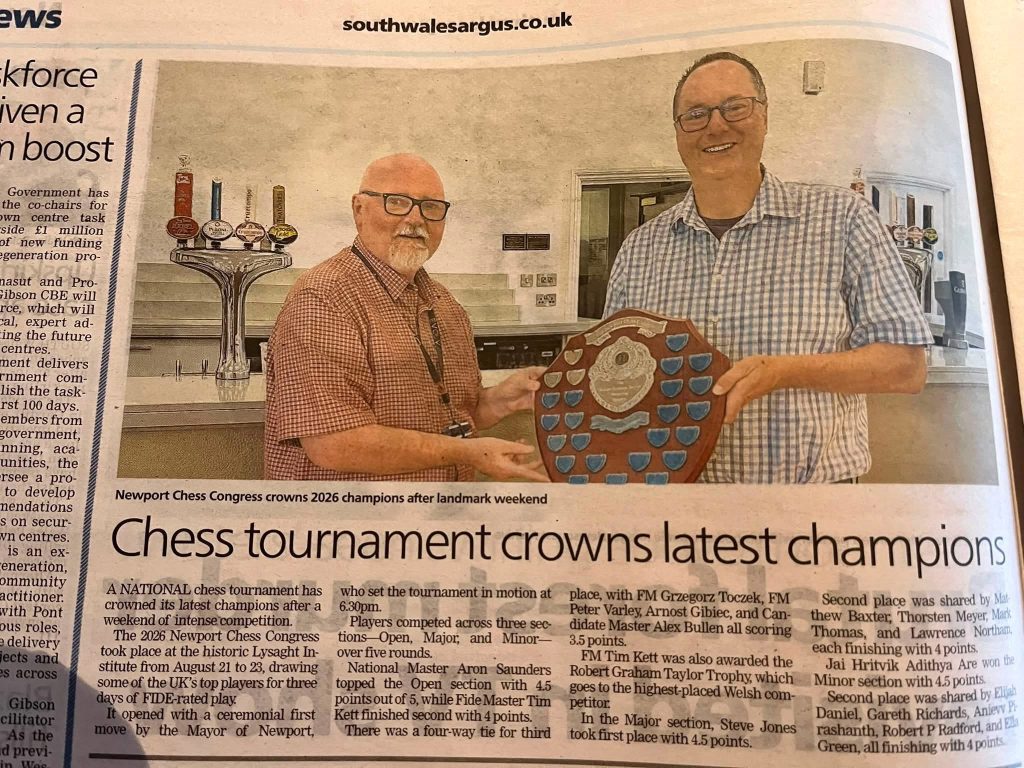
    I had a great experience organising the Newport Chess Congress this year, for the fourth time. It was a great privilege to present the prize for the highest placed Welsh contender to FIDE Master Tim Kett who also came second overall in the Open tournament of the Congress.

  • WIP

    WIP

    Here are my Works in Progress:

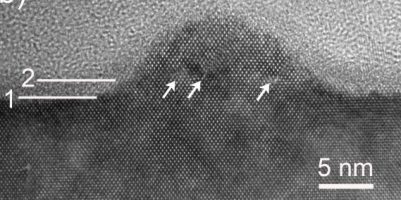
    The Quantum Dot is an attempt at presenting a complex technical process of semiconductor growth to a non-technical audience. It is currently in the process of being written. The story above (which you can click on) are excerpts as I continue to explore how to present this to a lay audience.

    An example in the picture above is an image of a quantum dot present on the surface of a flat wafer: presented is a cross-section of the quantum dot. The dot is made up of lots of tiny dots; these are the atomic columns visible at millions of time magnification in an electron microscope. These ‘atoms’ are what form the protrusion upon the wafer surface.

    This particular dot looks as if it is defective – the arrows point at planes which are not in synchrony with the surrounding material i.e. the overall structure is not perfectly pristine in structure. It has undergone relaxation with the formation of defects within the dot. This is not ideal – but not surprising either.

  • Starting Course

    Starting Course

    Hi there! I am starting a new course in Creative Writing at the University of Cardiff, Wales.

    Here, I’ll be putting some of the stories, for you to hopefully enjoy!

    Many thanks,

    Dave Norris (Davinor)